In the world of vintage cufflinks, silver is never just a material.
It can reveal origin, era, manufacturing culture, intended use and even a particular idea of elegance.
Most people look at the front of a cufflink.
Collectors eventually turn the piece over.
Very often, the back tells you more than the front.
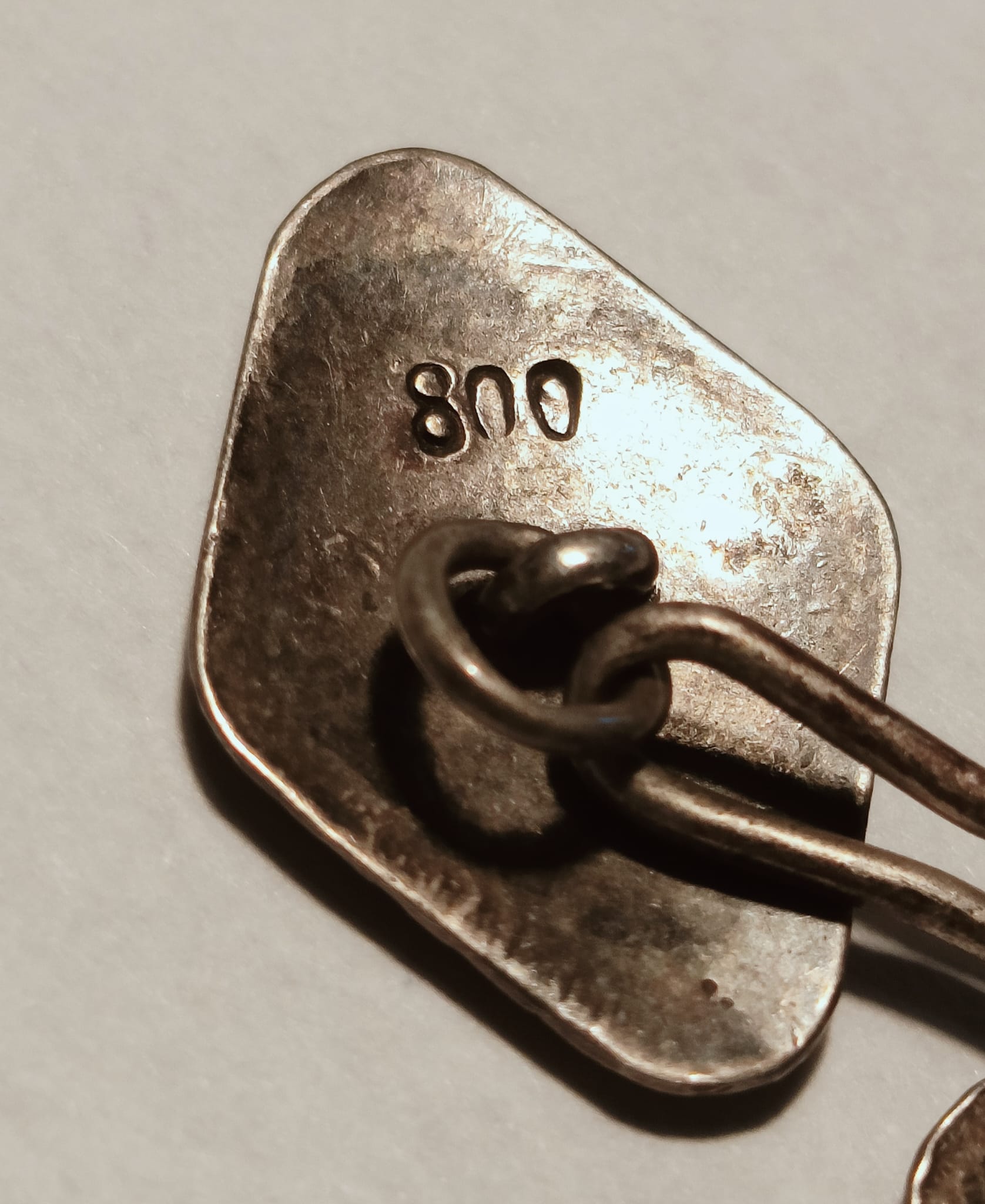
A small number — 800, 835 or 925 — may appear near the closure, on the reverse, on the bar or inside the mechanism. At first glance, it looks technical. In reality, it can tell a much larger story.
Three small numbers.
Three different silver standards.
Three different worlds of manufacture.
Quick Answer: What Do 800, 835 and 925 Mean?
The numbers 800, 835 and 925 indicate the purity of the silver alloy: the percentage of pure silver contained in the metal.
| Silver mark | Pure silver content | Other metals | Common association |
|---|---|---|---|
| 800 | 80% | 20% | Continental Europe, durability, practical manufacture |
| 835 | 83.5% | 16.5% | Germany, Netherlands, Northern Europe, restrained modernism |
| 925 | 92.5% | 7.5% | Sterling silver, UK/US, formal tradition and luxury production |
Pure silver is naturally too soft for most practical jewellery and men’s accessories. For this reason, it is alloyed with other metals — most commonly copper, though other metals may also appear depending on country, period and manufacturer.
In cufflinks, this matters. A cufflink is not a static object. It often includes moving parts, closures, chains, bars, bullet backs or rotating mechanisms. The alloy must not only look refined; it must also survive use.
But silver standards are not only technical.
They are cultural fingerprints.
800 Silver: Continental Practicality
800 silver was one of the most widespread silver standards across continental Europe, especially from the late nineteenth century through much of the twentieth century.
It appears frequently in vintage pieces from:
- Italy;
- Germany;
- Austria;
- France;
- Hungary;
- the broader Austro-German world;
- parts of Central and Southern Europe.
In vintage cufflinks, 800 silver is often found in pieces produced between approximately 1890 and 1960, though later examples also exist.
Why 800 Silver Was Used
800 silver offered several practical advantages:
- greater structural rigidity than higher-purity silver;
- lower production cost than 925 sterling;
- good resistance for small mechanical accessories;
- excellent workability for industrial and semi-artisanal production.
This made it particularly suitable for cufflinks.
A cufflink must be handled, inserted, rotated, fastened and removed. It is exposed to pressure, friction and small mechanical stresses. For this reason, a slightly harder alloy could be an advantage rather than a compromise.
The Aesthetic Character of 800 Silver Cufflinks
Vintage 800 silver cufflinks often carry a distinctly continental character: restrained, architectural, practical and less polished in the modern luxury sense.
Compared with 925 sterling, 800 silver can develop a warmer and slightly darker patina over time. On geometric, Art Deco, Deco Revival and mid-century designs, this can give the object a deeper visual presence.
A good 800 silver pair does not necessarily look “new”.
It looks selected.
Example from the Archive
Italian 800 Silver Gold-Plated Cufflinks, c. 1970s
Selected for their Deco Revival geometry, small scale and discreet formal presence.
These are not loud cufflinks.
Their interest appears up close — in proportion, surface and restraint.
835 Silver: Northern European Restraint
835 silver is less familiar to the general public, but it is highly important in European vintage jewellery and men’s accessories.
It was commonly used in:
- Germany;
- the Netherlands;
- Scandinavia;
- parts of Austria and Central Europe.
In cufflinks, 835 silver appears especially in pieces from the 1930s through the 1970s, including many postwar modernist designs.
Why 835 Silver Existed
835 silver sits between 800 and 925.
It is more refined than 800 in silver content, but still more pragmatic and structurally resistant than sterling silver. This made it suitable for elegant industrial production.
Many German, Dutch and Scandinavian cufflinks from the postwar period use this standard. These pieces often show:
- minimalist geometry;
- satin finishes;
- restrained surfaces;
- architectural proportions;
- functional closures;
- a rational, modern masculine aesthetic.
835 silver is deeply connected with a Northern European idea of elegance:
discreet, precise, never theatrical.
Why 835 Silver Matters Today
Many 835 silver cufflinks remain undervalued compared with more widely recognised sterling silver pieces. Yet experienced collectors often look for them because they can combine excellent design, strong wearability and understated quality.
A well-made German, Dutch or Scandinavian 835 pair from the 1950s or 1960s can still feel remarkably contemporary.
Example from the Archive
835 Silver Geometric Cufflinks, Scandinavian / German Design
Selected for their clean geometry, rational proportions and contemporary formal character.
They do not look old-fashioned.
They look precise.
Vintage does not mean old-fashioned.
It means selected.
925 Silver: The Sterling Standard
925 silver, also known as Sterling Silver, contains 92.5% pure silver.
It is the best-known silver standard internationally and is especially associated with British, American and higher-end formal production.
Sterling Silver and Formal Tradition
Sterling silver has a long history, particularly in Britain. In cufflinks, it appears frequently in British, American and international formal accessories throughout the twentieth century.
Within British culture, sterling silver is strongly associated with:
- formal dressing;
- gifting;
- ceremony;
- luxury accessories;
- traceable hallmarking;
- maker and assay office systems.
British sterling silver pieces can often be especially well documented because their hallmarks may include:
- silver standard;
- maker’s mark;
- assay office;
- date letter.
A mark smaller than a fingernail can sometimes reveal the city, year, maker and silver standard of the piece.
The Visual Character of 925 Silver
925 silver usually has brighter reflections and a clearer, more visibly precious appearance than lower silver standards.
However, because it contains more pure silver, it is also slightly softer. This means that well-made sterling cufflinks often require careful construction, thicker mountings, reinforced parts or strong design to remain durable over time.
Sterling silver can be beautiful.
But purity alone does not make a cufflink important.
Design, construction and proportion still matter.
Example from the Archive
Sterling Silver Cufflinks, Edinburgh Hallmark, 2001
Selected for their traceable hallmark, formal restraint and precise British silver tradition.
In this case, the hallmark does not simply confirm material.
It gives the object a date, a place and a maker.
Why Different Countries Used Different Silver Standards
The differences between 800, 835 and 925 silver were never random.
Different countries and manufacturing cultures developed different standards according to practical, economic and aesthetic priorities.
Continental Europe
Continental Europe often favoured durability, practicality and industrial workability. This helps explain the widespread use of 800 silver in many European cufflinks and accessories.
Germany, Netherlands and Northern Europe
Northern and Central Europe often favoured precision, functional elegance and restrained modern design. 835 silver suited this culture particularly well.
Britain and the Anglo-Saxon World
Britain, the United States and international formalwear traditions often associated silver with ceremony, gifting, status and traceable hallmarking. This helped establish the prominence of 925 sterling silver.
The silver standard is therefore more than a number.
It can be a clue to origin, mentality and intended use.
Which Silver Standard Is Better?
None of them is automatically better.
An exceptional 800 silver pair can be more interesting than an average 925 sterling pair. A beautifully designed 835 pair can feel more contemporary than a heavier sterling piece. A sterling silver pair can be valuable, traceable and refined — but still ordinary if the design is weak.
In vintage cufflinks, value depends on the whole object.
Important factors include:
- design;
- proportions;
- material;
- closure quality;
- maker;
- country of origin;
- era;
- condition;
- rarity;
- wearability;
- visual presence.
Silver purity matters.
But it is never the whole story.
As with most genuine collectible objects:
selection matters more than perfection.
How to Find the Hallmark on Vintage Cufflinks
On vintage cufflinks, hallmarks are usually small. Sometimes they are worn, partially hidden or positioned in places that require close inspection.
Look carefully in these areas:
- on the reverse face;
- near the closure;
- on the connecting bar;
- inside the mechanism;
- on the chain link;
- along the edge of the cufflink face.
Useful tools include:
- a loupe;
- a macro photograph;
- strong side lighting;
- a clean neutral background.
Common marks include:
- 800
- 835
- 925
- Sterling
- Sterling Silver
- maker’s marks
- assay marks
- date letters
- national silver marks
Learning to study the back of a cufflink is essential.
The front reveals the style.
The back usually tells the truth.
Why These Details Matter
A pair of vintage cufflinks is never just an accessory.
It is a small industrial object, an aesthetic decision, a trace of formal behaviour and sometimes a fragment of a manufacturing culture that no longer exists.
The numbers impressed into silver — 800, 835, 925 — do not simply indicate purity.
They can reveal:
- origin;
- era;
- intended use;
- manufacturing culture;
- durability;
- refinement;
- a particular idea of elegance.
This is why collectors turn the piece over.
Because the real story often begins on the back.
Small objects.
For men who notice.
FAQ
Is 800 silver good quality?
Yes. 800 silver is a legitimate and widely used silver standard, especially across continental Europe. It contains 80% pure silver and 20% other metals, usually including copper.
It is generally harder and more resistant than 925 sterling silver, which made it practical for cufflinks and other small accessories with moving parts. Many Italian, German and Central European vintage cufflinks were made in 800 silver.
What does 835 mean on silver?
835 means the piece contains 83.5% pure silver. The remaining 16.5% is made of other metals, commonly copper and sometimes other alloying metals depending on country and period.
835 silver is especially associated with Germany, the Netherlands, Scandinavia and parts of Central Europe. It is often found in well-designed vintage cufflinks from the mid-twentieth century.
Is 835 silver the same as sterling?
No. Sterling silver is the 925 standard, meaning 92.5% pure silver.
835 silver contains 83.5% pure silver. Both are genuine silver standards. The difference is not simply “better” or “worse”; it reflects purity, tradition, geography and intended use.
What does 925 mean on silver cufflinks?
925 means the cufflinks are made of Sterling Silver, containing 92.5% pure silver.
This standard is especially common in British, American and international formal accessories. In British pieces, the hallmark may also reveal the maker, assay office and date letter.
Which silver standard is most valuable in vintage cufflinks?
Silver standard alone does not determine value.
A well-designed 800 silver pair can be more desirable than a poorly designed 925 pair. What matters most is design, condition, rarity, maker, provenance, construction quality and visual presence.
How do I find the hallmark on a vintage cufflink?
Turn the cufflink over and inspect the reverse, bar, closure or chain link. Hallmarks are often very small, so use a loupe or macro photograph.
Look for numbers such as 800, 835 or 925, as well as words like Sterling, maker’s marks, assay marks or date letters.
Browse Vintage Silver Cufflinks
Explore selected vintage silver cufflinks from The Cufflinks Collector, including 800, 835 and 925 silver pieces.
Each available pair is documented with material, condition, closure type and signs of age.
View available silver cufflinks
Request a similar pair