Small Objects, Quiet Authority, and the Collector’s Eye
In a world that moves faster and faster, cufflinks ask for something simple: to slow down.
Even if only for a moment.
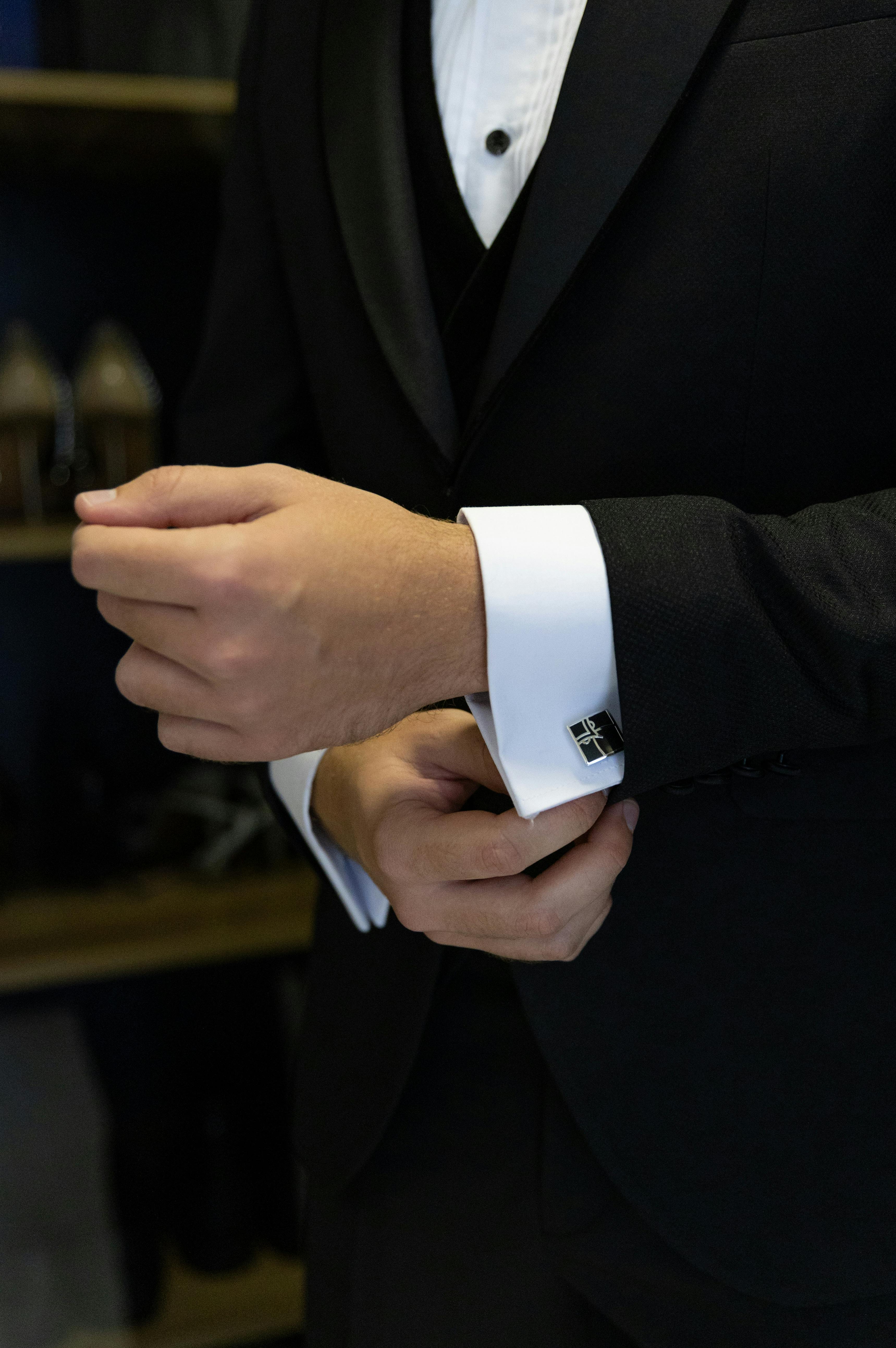
They are not usually worn without a moment of attention. They are chosen, picked up, observed. Then the cuff is fastened with a precise gesture, almost a small ritual. You feel the weight of the metal, the finish of the surface, the certainty of the mechanism. And then you step out with a detail that does not ask for attention, but changes the whole tone of a shirt.
To me, cufflinks are exactly this: the smallest sign of elegance, and perhaps the most personal one.
They sit close to the hand, close to daily gestures, close to the handshake. A good pair does not need to shout. It simply holds its line: proportion, material, construction. These are things one learns to recognise over time, after handling many pairs, looking closely, observing how they are made and how they have aged.
That is why cufflinks endure. They live in a particular space, where utility meets craft.
A brief history, without unnecessary mythology
Objects used to fasten cuffs have existed in different forms for centuries, but the cufflink as we think of it today belongs to a more modern history of dress: more structured shirts, more defined cuffs, cleaner tailoring, and the idea that even the smallest sartorial details could be chosen with intention.
Early examples often resemble linked buttons: two faces joined by a chain or a bar. Later came more varied, more practical, more industrial mechanisms: fixed bars, pivots, chains, toggles, T-bars.
But for a collector, the most interesting thing is not to search for a single origin, a definitive date, or an overly simple story. The interesting thing is to read how each period left its mark on these small objects.
A pair from the 1920s does not think like a pair from the 1960s.
An English cufflink does not always share the same sensibility as an Italian one.
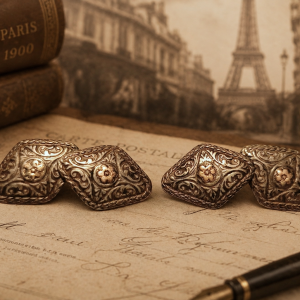
An evening pair speaks a different language from an American corporate cufflink, a piece of continental silver, a colourful enamel design, or a pair in mother-of-pearl.
Every period has its own way of understanding form, material, finish, and mechanics. Learning to read these differences is one of the great pleasures of collecting.
Different cultures, the same small gesture
Although much of the documented history of cufflinks passes through English tailoring, European silver, and the world of formal Western dress, the cufflink does not belong to one culture alone.
In the United States, the twentieth century produced many corporate, university, and institutional cufflinks: small objects in silver or metal, connected to belonging, clubs, professions, and special occasions. Some of them are surprisingly beautiful, precisely because they were made to represent something.
In Japan, certain decorative metalworking traditions also crossed into the world of cufflinks, especially in pieces made for export in the early twentieth century. In some cases, the surface becomes almost a small scene, a miniature landscape, an exercise in patience and precision.
These traditions are different, but they share the same underlying idea: that a small, well-made object worn close to the hand can carry identity, memory, belonging, and taste.
Without needing to announce it.
The mechanism: the small engineering that matters
Those who do not collect cufflinks tend to look mostly at the front: the shape, the colour, the material. That is natural. But the back matters a great deal.
The mechanism says a lot about the piece. It tells you how it is worn, how comfortable it is, how stable it sits on the cuff, how much it has been used, and how carefully it was made.
Chain link cufflinks have a traditional charm. They move slightly, with a softness that suits a classic wardrobe. They may rotate a little if the cuff is loose, but they have a grace that is difficult to imitate.
Toggle or T-bar cufflinks are more modern and practical. They are secure, quick, reassuring in the hand. When well made, the swivel has a precise quality: not loose, not uncertain, but deliberate.
Fixed-back cufflinks, without moving parts, are clean and robust. Their advantage is simplicity: no pivots to wear out, no mechanism to check. But they are more sensitive to cuff thickness. When they work with the right shirt, they are wonderful. When they do not, they tell you immediately.
That is why the mechanism is not a secondary detail. It is part of the cufflink’s character.
It affects how the piece sits on the wrist, how still it remains, how it appears in profile, and how pleasant it is to use.
Materials: what ages well, and what tells the truth
Cufflinks teach a beautiful lesson: materials do not all age in the same way.
Sterling silver develops patina in the recesses and softness on the exposed points. When polishing a pair of silver cufflinks, one is not simply “removing age”. One is choosing what kind of presence to give them: brighter and sharper, or deeper, more shadowed, more lived-in.
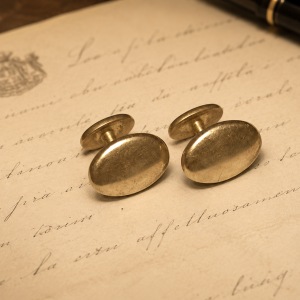
Gold, whether solid or applied, behaves differently. It is warmer, steadier to the eye, often more forgiving. Even a small touch of gold can change the entire tone of a pair.
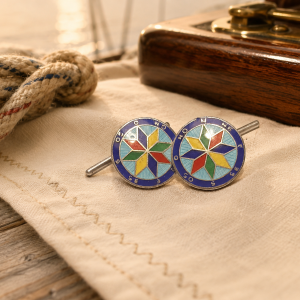
Enamel brings colour with great authority. But it asks for respect. It should be examined carefully, especially around the edges. A small crack, a loss, a fine line can tell a lot about the condition of the piece. These are not details to hide. They are details to state clearly.
Stones and inlays — onyx, carnelian, mother-of-pearl, amber, glass, bone, natural materials — add mood, temperature, and depth. But they also bring vulnerability. A collector quickly learns to look at the corners, not only at the flattering front photograph.
Then there are plated and mixed-material pieces. Some are excellent. Others are merely shiny. The difference is often visible at the edges, in the joins, and in the way wear presents itself. A good plated cufflink ages with a certain dignity. A mediocre one loses its illusion quickly.
A serious description does not pretend. It says what is visible, what is supported by marks or testing, what is a reasonable estimate, and what cannot be claimed with certainty.
To me, this is a fundamental part of the work.
The collector’s method: learning to look
Buying cufflinks well is not only about “having taste”. Taste matters, of course, but by itself it is not enough.
Attention is needed.
I almost always begin with proportion. Does the face of the cufflink suit the cuff? Is it too large? Too small? Too dominant? Does its shape accompany the wrist, or does it look as if it has simply been placed there by chance?
Then I look at the finish. Are the edges clean? Has the surface been handled with care? Is the design still legible, or has it been softened too much by wear? Is there balance between the two parts of the pair?
Symmetry matters. Not because everything must be perfect, but because the two cufflinks must belong to each other. They should share the same tone, the same wear, the same presence. If one has lived much harder than the other, that needs to be understood and stated.
Finally, I look at the mechanism. It should be secure, proportionate, and coherent. A loose swivel, a bent bar, or an over-polished back can change the entire experience of using the pair.
Marks help, when they are present and legible. A hallmark can anchor a piece to a place, a period, and a production tradition. But the absence of marks does not automatically mean the absence of quality. It simply means we must be more careful about what we claim.
That caution matters to me.
It is the difference between a simple listing and a true catalogue entry.
If something is verified, say so.
If it is an estimate, state it.
If it is only a hypothesis, keep it humble. Or leave it out.
Wearing them today
Cufflinks are often treated as occasion-only objects: weddings, ceremonies, black tie, formal evenings.
I understand why. But I think it is a limitation, and a slightly melancholy one.
Style, real style, should not be something saved for rare moments. It should be lived in. A pale blue shirt, a pair of silver cufflinks, a simple jacket: sometimes that is more elegant than many accessories designed specifically to be noticed.
The point is not to be formal.
The point is to be attentive.
For work, restrained cufflinks work best: clean metal, modest shapes, quiet finishes. For the evening, the material can speak a little more: a dark stone, deep enamel, luminous but discreet mother-of-pearl.
At the weekend, with more textured fabrics — flannel, tweed, knitwear, less rigid jackets — patina can be particularly beautiful. Cufflinks that have lived a little suit clothes that have lived a little.
And then there are ordinary shirts, the ones we truly love. A double cuff is not always necessary. A shirt with a single cuff can be adapted by a tailor with a second buttonhole, and then cufflinks become less formal, more everyday, more natural.
They remain elegant, but no longer distant.
Why all this matters
A pair of cufflinks is a small object. But it can carry a great deal.
The taste of an era.
The intelligence of its construction.
The intention behind its design.
The patience of the person who made it.
The quiet pleasure of the person who wears it.
That is why I collect them. And that is why I catalogue them with care.
The Cufflinks Collector began as a personal archive: part collection, part diary, part small living museum. Some pieces are available to purchase. Others remain in the collection, shown simply because they deserve to be seen and remembered.
The intention is simple: to treat cufflinks with the respect usually reserved for more obvious collectibles. To give them back attention, context, and truth. To offer a more considered alternative to anonymous marketplaces, where the story of a piece, its craft, and even its real condition can so easily be lost in a few hurried photographs.
A good pair of cufflinks does not ask for much.
Only a cuff worth fastening.
And an eye willing to notice.